The easiest way to choose interior wall paint colours is in three steps: first assess the light and size of the room, then build a harmonious palette using the colour wheel, and finally pick the type of paint that suits the room’s use (washable for kitchens and hallways, breathable for bedrooms, mould-resistant for bathrooms). Always test the shade on the wall itself, not just on a colour chart.
Light and room size: why the same colour never looks the same
The same shade looks different in every room. The final impression depends on the size of the room, the amount of daylight and artificial light, and large surfaces nearby – flooring, kitchen units, the sofa. That is exactly why so many people are disappointed when they choose a colour from a swatch in the shop.
- North-facing rooms get cooler, diffused light. Warm shades (cream, sand, warmer greys) work better here, adding some warmth to the cool light.
- South-facing rooms are bright and warm, so they can take cooler tones such as blue-greens or grey-blues.
- Small rooms look larger in light shades. Save a dark colour, such as deep teal or dark plum, for a single wall.
- Ceilings should usually be lighter than the walls – this makes the room feel taller.
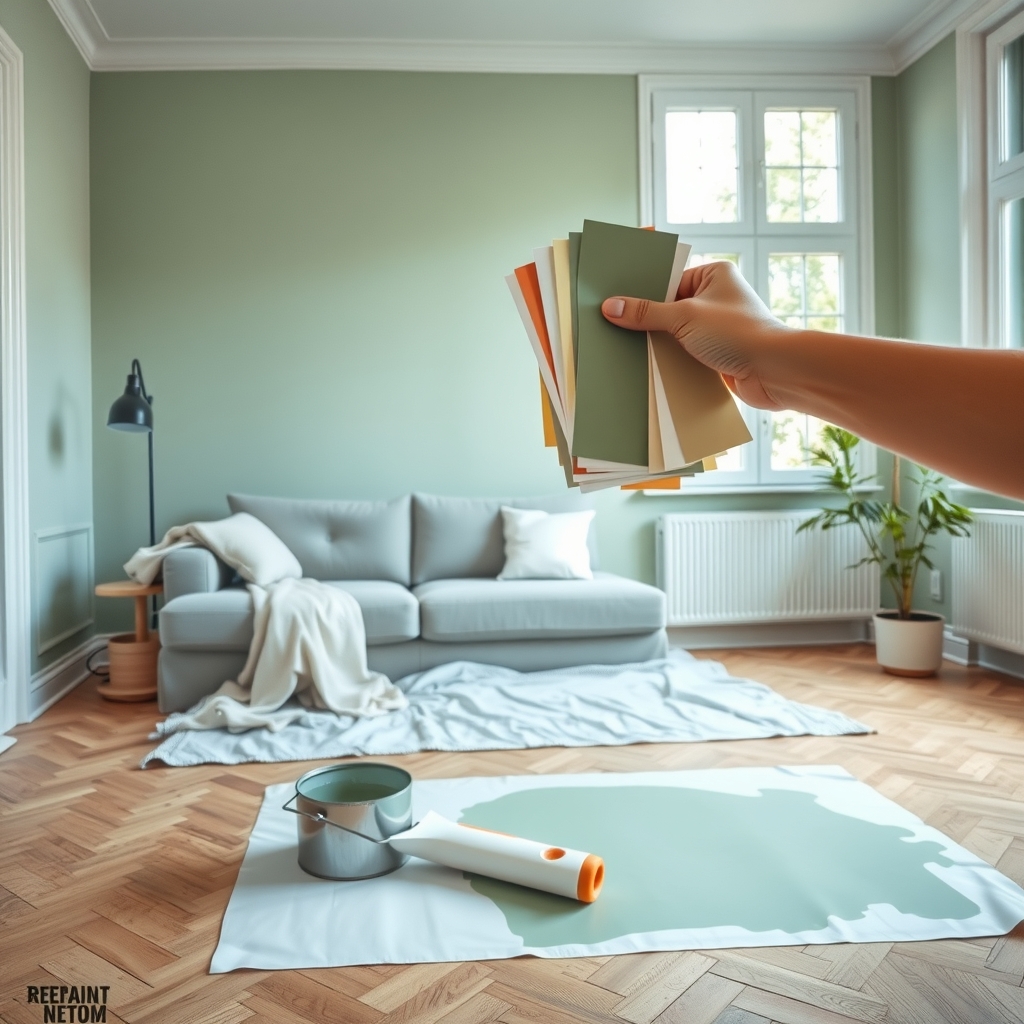
Before buying a large amount, paint a sample on the wall and watch it for 24 to 48 hours: in the morning, the afternoon and the evening with the lights on. Larger paint shops often hand out small sample pots for free or for a small charge.
The colour wheel: primary, secondary and harmonious colours
The colour wheel is the simplest tool for creating combinations that work. The primary colours are red, yellow and blue – mixing them gives the secondary colours: orange, green and purple. Between them sit the tertiary, in-between shades.
Three tried-and-tested colour harmonies
- Analogous harmony: three colours that sit next to each other on the wheel, e.g. green, blue-green and blue. It feels calm and is the safest choice for a living room or bedroom.
- Complementary harmony: colours on opposite sides of the wheel (blue and orange, green and red). It creates strong contrast, so let one colour dominate and use the other only as an accent.
- Monochromatic scheme: several lighter and darker tones of one colour. It suits smaller spaces and a minimalist style.
Neutrals help to balance any harmony: white lightens a shade, black darkens it and grey tones down an over-saturated colour. The paint maker JUB, for example, recommends using calmer versions of intense shades – see their guide to analogous colour harmony.
The 60-30-10 rule and wall decoration
Interior designers often rely on the 60-30-10 rule. Around 60 per cent of the colour in a room comes from the walls, 30 per cent from upholstered furniture, flooring and curtains, and 10 per cent from decor – pictures, cushions, plants. Keep the dominant colour calm, choose the second as a complement and use the third only for accents.
Wall decoration starts with the paint itself. A single feature wall behind the bed or sofa adds depth without the risk of making the room too dark. Balance dark walls with a light ceiling, wood and soft textiles; small gold or silver details add elegance. With grey, the rule is simple: stronger tones on one wall, while light, soft greys can cover larger areas.
Which colour to choose for which room
| Room | Recommended shades | Type of paint |
|---|---|---|
| Living room | warm neutrals, analogous harmonies, one feature wall | matt emulsion, reduces glare |
| Bedroom | calm blues, greens, dusty pink, sand | matt, breathable |
| Kitchen | light, fresh tones (yellow, light green) | washable, resistant to grease and stains |
| Bathroom | light, clean tones | washable, for damp rooms, with mould protection |
| Children’s room, hallway | pastel shades, lively accents | highly washable |
| Ceiling | white or off-white | non-washable or breathable |
Types of interior paint: emulsion, lime and washable
Emulsion (dispersion) paints are the most common: they dry quickly, cover well and suit every room. Lime paint is natural and breathable, and the lime makes it fungicidal and antiseptic, so it is a good choice for damp and older walls – but it is not washable. Non-washable paints are the cheapest and suit ceilings and less-used rooms; they usually need two coats. Washable paints contain more binder, so you can clean them with a damp sponge and a mild detergent.
In Europe, washability is classified under the EN 13300 standard in classes from 1 (most resistant to wet scrubbing) to 5. For hallways, kitchens and children’s rooms, choose class 1 or 2. On damp, cold walls (basements, north walls, old houses) avoid sealing the wall with impermeable coatings, as they can trap moisture.
How much paint you need and how to paint
You will find the coverage in the paint’s technical data sheet. For JUB Jupol Classic, a popular paint in Slovenia, it is 150–190 ml/m² for two coats. A room measuring 4 × 3.5 m with a ceiling height of 2.6 m has about 39 m² of walls, or roughly 34 m² without windows and doors – which means about 5–6.5 litres of paint for two coats. Buy enough for both coats at once and note the colour code, as a later tinted batch is hard to match exactly.
- Clean the wall, fill any damage with filler and sand it smooth once dry.
- For a first coat on new or absorbent surfaces, apply a primer or bonding emulsion.
- Remove mould before painting and fix its cause; cover nicotine and grease stains with a stain-blocking paint.
- Apply the first coat, wait (4–6 hours at 20 °C for Jupol Classic) and apply the second.
- Paint when air and wall temperatures are between +5 and +35 °C and relative humidity is no higher than 80%.
Frequently asked questions
Which wall colour makes a small room look bigger?
Light, slightly warm or neutral shades (off-white, light grey, sand) reflect more light and visually widen the space. Keep the ceiling even lighter than the walls and use dark shades only on one wall or in accessories.
How many coats of interior paint do I need?
Usually two. When going from a dark to a light colour, apply a high-hiding white first and then the tinted top coat; with highly washable paints over a similar colour, one coat is sometimes enough.
Which paint is best for kitchens and bathrooms?
Choose a washable paint with a high wet-scrub resistance class under EN 13300, and in bathrooms a paint that tolerates moisture and has mould protection. Regular ventilation matters just as much.
How do I test a colour before painting the whole room?
Apply a sample at least the size of an A4 sheet and observe it for 24 to 48 hours – in the morning, afternoon and evening under artificial light, next to the furniture and flooring that will stay in the room.